Overview
When an agent fails, the instinct is to blame the model — wait for the next release, and reliability will come. Our benchmark data says otherwise: most production failures happen at the seams, where an agent meets a tool, a collaborator, or its own history through an unstructured interface.
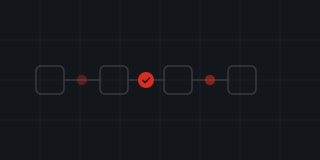
The pattern is error compounding. A 98%-reliable step is fine alone and catastrophic in a twenty-step chain — under 70% end-to-end. You can't fix compounding with a smarter model; you fix it by making each seam checkable, so errors are caught at the step where they happen instead of surfacing five steps later as nonsense.
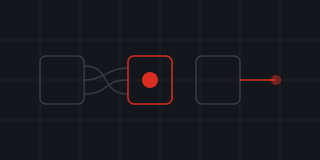
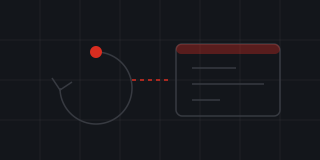
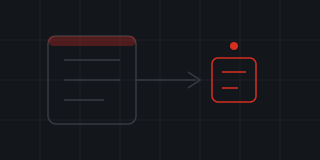
Checkable seams are what protocols are. A typed tool interface rejects a malformed call instantly — that's a retry, not a derailment. A validated component tree either conforms to schema or doesn't. Structured hand-offs between agents mean a dropped task is detected by the protocol, not discovered by the user.
Our multi-agent coordination benchmarks make the same point from the other direction: swap the models inside an agent stack and scores move modestly; swap unstructured seams for protocol-mediated ones and failure rates fall by multiples. The interface dominates the intelligence.
This is good news, because interfaces are engineering, not research luck. You don't have to wait for a better model to ship a reliable agent — you have to structure the seams. The protocol specs we publish are exactly that work, and they're open.