Overview
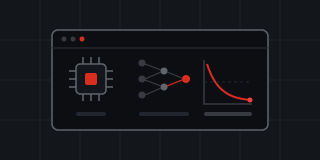
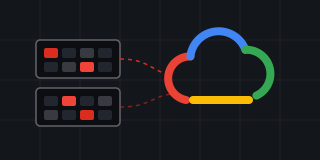
LegionEdge and Google Cloud are entering a formal partnership. A dedicated cluster of NVIDIA H200 Tensor Core GPUs is now online on Google Cloud, reserved for model training, dataset generation, and the open research that lands in our registry.
The partnership runs in both directions: Google Cloud carries our heaviest workloads, and Google Cloud becomes a first-class target across everything we ship — Foltrac deploys to it natively, and LegionEdge Cloud schedules training and inference on it, including capacity you bring yourself.
Compute for open research
The cluster is aimed at the work we publish. High-memory H200s mean larger training runs and roughly 3x faster experiment turnaround on the largest jobs — the difference between queueing a run for days and scheduling it like engineering work.
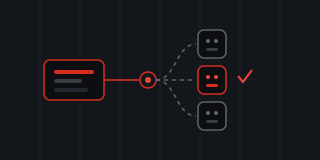
Every sample in our synthetic data releases passes a validation gauntlet — parse, execute, mutation-check — and that gauntlet now runs entirely on the Google Cloud cluster. All of our open-dataset validation happens there.
A first-class target, not a preferred one
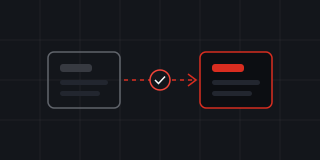
Foltrac translates one deployment definition to Google Cloud natively, the same way it does for AWS — the partnership deepens the integration without narrowing your options. Multi-cloud stays the product.
For LegionEdge Cloud, it covers both sides of the bring-your-own-compute story: our dedicated capacity lives on Google Cloud, and attaching your own Google Cloud projects is the shortest path to running under your existing bill.
What's next
Capacity grows through the year, tracking demand from LegionEdge Cloud's launch this week. Reserved headroom is what makes training runs and dataset releases schedulable, and we intend to keep it that way.
There's also joint work ahead on scheduling agent workloads — long-running, bursty, verification-heavy — which behave differently from both batch training and web serving. Expect research, not just capacity, to come out of this partnership.